

Updated: April 2026
By Françoise Pollard, Realtor®, and Keith Goldson, Broker, Keith & Françoise Real Estate Team, eXp Realty Brokerage. We help homeowners weigh the local-versus-relocate downsizing decision across the GTA and Niagara Region, including Mississauga, Brampton, Milton, Burlington, Oakville, Hamilton, Etobicoke, Toronto, St. Catharines, Niagara Falls, Welland, Thorold, and Grimsby. We have walked dozens of clients through the local-versus-relocate decision in established GTA suburbs, and we made that same decision ourselves in 2025.
You can downsize without leaving your community in Ontario, but the process is usually more constrained than a move to a new area. Bungalows and smaller homes are genuinely scarce in many established GTA neighbourhoods. That means tighter inventory, more competition, and longer timelines. Confirm what’s realistically available before setting firm expectations. If local options fall short, expanding to a nearby community or considering the GTA-to-Niagara corridor opens up the rest of your options.
On This Page
Why Staying Local Changes Your Downsizing Plan
You can downsize and stay in your community in many parts of Ontario, but the inventory of smaller homes in established GTA neighbourhoods is genuinely limited. That means tighter timelines and stronger competition for the right property.
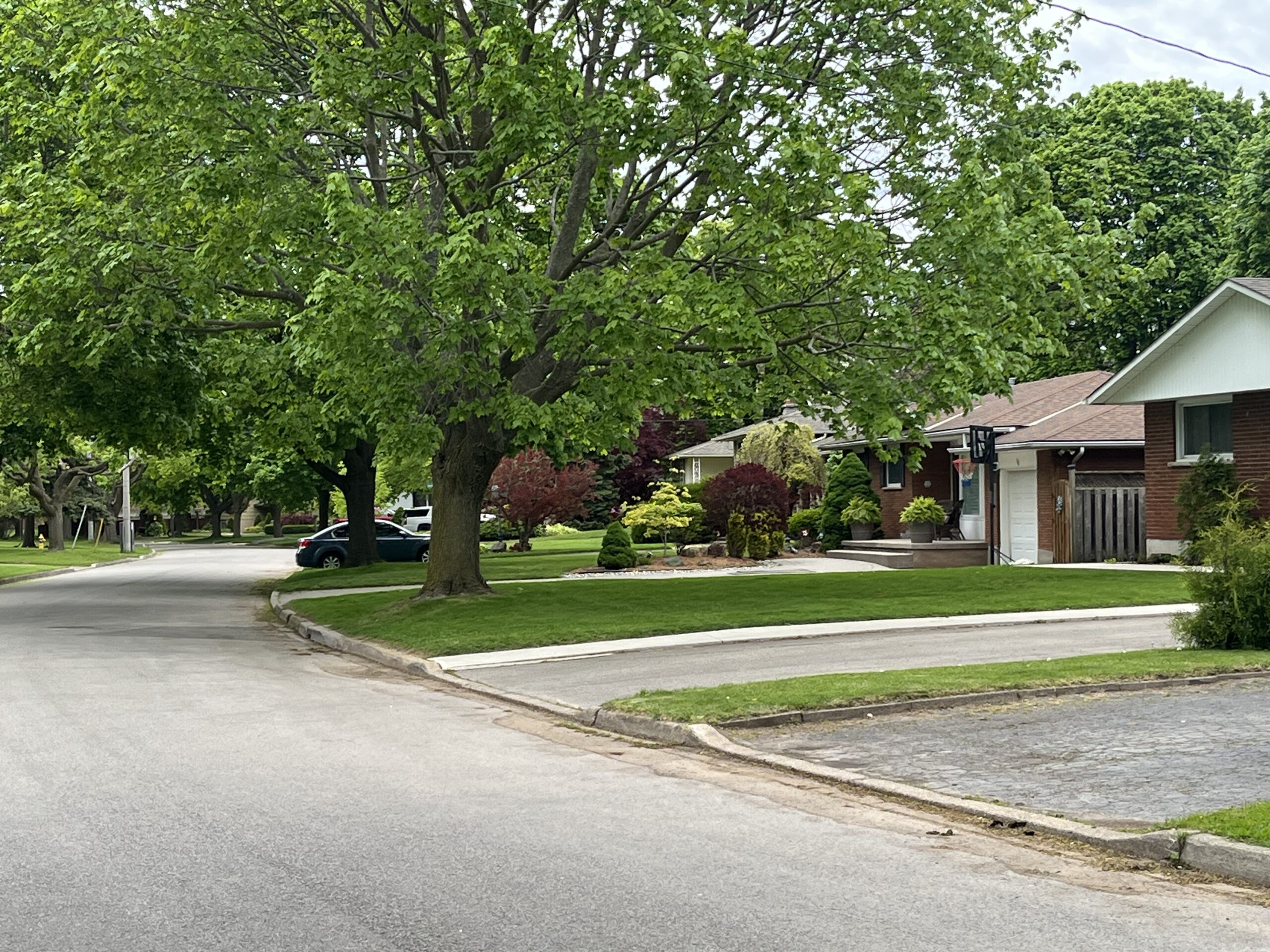
It’s also a goal we hear nearly every week, and one that often runs into a quieter reality. In many established GTA suburbs, developers built most of the housing stock over a short period and it tends to cluster around one type. Etobicoke’s postwar subdivisions are largely three-bedroom detached homes. North Mississauga’s mature pockets feature sprawling lots with homes well above 2,000 square feet. Burlington’s older neighbourhoods near the lake are similar. Bungalows and smaller homes that suit downsizers make up a small share of listings, and buyers bid them up quickly when they appear. That single dynamic shapes every other planning decision: your timing, your pricing expectations, and the sequence of your sale and purchase.
For the full decision sequence, see our complete guide to downsizing in Ontario.
Where Inventory Is Tightest in the GTA
Bungalow supply is the clearest indicator of how constrained a local downsize will be. In Mississauga, bungalow inventory typically sits in the low triple digits at any given time, a small fraction of overall active listings. Median list prices for updated bungalows in established neighbourhoods like Applewood, Clarkson, Cooksville, Lakeview, and Lorne Park run well above $1 million, and well-priced properties move quickly even in a softer overall market.
In Etobicoke, the supply picture is similar. Bungalow inventory in any given month is typically a small fraction of overall listings. Pricing varies widely by condition and neighbourhood, with updated properties in Mimico and Alderwood frequently selling above the suburb’s broader average. Builders almost never add new bungalows in these established neighbourhoods, so supply stays static while demand from downsizers, investors, and families grows.
Burlington’s older neighbourhoods near the waterfront face the same dynamic. Smaller single-level homes exist, but they cluster on a few specific streets and rarely last long on the market. Hamilton offers somewhat better bungalow variety in neighbourhoods like Dundas and Ancaster, though prices have climbed steadily in both areas.
In the Niagara Region, the inventory picture is different. St. Catharines, Welland, and Thorold all offer a wider range of bungalows and smaller homes at significantly lower price points. That contrast is one reason the GTA-to-Niagara corridor has become such an active downsizing route.
Realistic Housing Options for Local Downsizers
If you want to downsize without leaving your community, your housing options likely fall into three categories. Each comes with specific trade-offs worth understanding early.
Bungalows and single-level homes
These are the most popular choice for downsizers who want to stay local. They’re also the most constrained category in most GTA suburbs. If one comes up in your target neighbourhood, expect competition. A pre-approval and a clear offer strategy matter here, even in a softer overall market. Starting your decluttering and space planning early also matters because the move from a 2,500-square-foot home to a 1,200-square-foot bungalow is significant.
Low-rise condos
Low-rise condos in established GTA neighbourhoods work well for downsizers who want familiar routines with less upkeep. Monthly fees typically range from roughly $500 to $1,000 depending on the building’s age and amenities. Always review the status certificate, reserve fund study, and recent board meeting minutes before committing. For a deeper comparison, see our condo vs. bungalow guide for GTA downsizers.
Freehold and condo townhomes
Townhomes offer a middle ground: less square footage and upkeep than a detached home, but more space than a typical condo. Freehold townhomes give you land ownership with no monthly maintenance fee. Condo townhomes include shared services at a monthly cost. Both are increasingly common in GTA communities. New townhome developments in Milton, Oakville, and Brampton offer modern layouts designed for easy living.
Ontario’s New Rules for Additional Residential Units
Ontario Regulation 462/24 came into force in November 2024. It allows up to three residential units on a single property across the province. This means homeowners in many municipalities can add a garden suite, basement apartment, or laneway house to an existing lot.
For downsizers, this regulation creates an option that didn’t exist a few years ago. If your property is large enough, you could build a smaller unit on the lot and move into it while renting or selling the main house. Federal mortgage insurance rules that took effect January 15, 2025 also allow homeowners to refinance up to 90% of the post-renovation value of their home, up to $2 million, amortized up to 30 years, to fund secondary suite construction. That refinancing option is the realistic federal lever for funding a garden suite or basement conversion as part of a downsizing plan. Confirm current eligibility and lender availability with a licensed mortgage professional before committing to a build.
This path is not simple. Municipalities are still updating their zoning by-laws to align with the provincial regulation, and construction timelines and costs vary widely. However, for homeowners who want to stay on their own property while reducing their footprint, it is a genuine option. Talk to a qualified builder and your local planning department to explore it further.
Timing Strategies When You Want to Stay Close
Timing is the biggest variable when you want to downsize without leaving your community. Because your target inventory is limited, you cannot always control when the right property appears. These strategies help manage that uncertainty.
Set up a dedicated MLS alert early and check it daily. In a constrained inventory market, the right property may come and go within 48 hours. We set up targeted alerts for clients so nothing slips through, and we coach them on what a fast-moving offer looks like before they need to make one.
Sell first and rent locally if needed. Selling first gives you a firm equity number and removes the pressure of coordinating two transactions in the same tight market. A short-term rental in your own community keeps you local while you wait for the right purchase. If renting becomes the longer-term plan rather than a bridge, our guide to renting versus buying after downsizing in Ontario walks through that decision in detail.
Negotiate a longer close on your sale. In the current GTA buyer’s market, many purchasers will accept a 90-day or longer closing period. That extra time gives you a window to find and firm up your next home before your sale completes.
Consider a seller leaseback. A leaseback lets you stay in your current home after the sale closes. You rent it from the buyer for a defined period. This keeps you in the neighbourhood while you finalize your purchase without the cost of bridge financing.
For a week-by-week breakdown of the typical downsizing sequence, our Ontario downsizing timeline and checklist maps the full process from decision to closing.
When Expanding Your Search Radius Makes More Sense
The desire to downsize without leaving your community is a strong preference, not an absolute requirement. If local inventory is too limited or your timeline stretches beyond six months, it may be time to look at adjacent communities. The same applies when local pricing no longer aligns with the financial goals of your downsize.
Nearby GTA alternatives
Expanding your search does not always mean leaving the region entirely. Oakville downsizers often find better bungalow inventory in Burlington. Scarborough downsizers regularly look at Pickering and Ajax. East-end Toronto clients sometimes find what they need in Whitby. These shifts keep you close to family, doctors, and routines while opening up significantly more inventory than a single neighbourhood can offer.
The GTA-to-Niagara price gap
For many GTA homeowners, the expanded search eventually leads to the Niagara Region. The equity from a sale in Mississauga, Etobicoke, or Burlington often covers a full purchase in St. Catharines or Welland with cash left over. The GTA average sold price in February 2026 was $1,008,968 (TRREB). The Niagara Region MLS® benchmark for the same month was $571,800 (CREA). That gap is substantial. For many downsizers, it represents both financial freedom and a lifestyle upgrade that local downsizing cannot deliver.
We made this move ourselves in 2025, downsizing from Vaughan to St. Catharines. Leaving the GTA was not easy. However, the outcome exceeded what we expected, both financially and in daily quality of life. If you want to see exactly what your equity would buy in a specific Niagara community, that is a conversation we have all the time. Reach out and we will run the math with you. For the full picture of both paths, our complete downsizing guide covers the local-versus-relocate decision in detail.
We’ve Seen This Play Out
We had clients in North Mississauga who were certain they wanted to stay in their neighbourhood after their kids moved out. They had lived there for 22 years. After three months of watching the local market, only two bungalows came up in their target area. Both exceeded their budget and both sold within a week.
The turning point was a weekend visit to St. Catharines. Within two weeks, they found a home near the lake that gave them everything on their list at roughly half the cost. They still drive to Mississauga regularly to see family. They told us the move gave them something unexpected: the sense of starting a new chapter instead of just shrinking the old one.
Local Downsizing in Ontario: Your Questions Answered
Can I downsize and stay in my neighbourhood in Ontario?
Yes, but it depends heavily on what housing is available locally. In many established GTA suburbs, bungalows and smaller homes make up a small fraction of total inventory. That limits options and can extend your timeline. Confirming what’s realistically available in your specific area before committing to a plan is the most important first step.
Why are bungalows so hard to find in GTA suburbs?
Developers built most GTA suburbs with a narrow range of housing types, primarily two-storey detached homes. Very few new bungalows go up in established neighbourhoods, so supply stays static while demand from downsizers, investors, and families grows. The result is that bungalow inventory in most GTA suburbs sits well below 1% of total active listings, with well-priced properties selling quickly even in a softer overall market.
Should I consider a condo if I want to stay in my community?
A condo can be a practical option if low-rise buildings exist in your target area. Monthly fees in the GTA typically range from $500 to $1,000 depending on the building’s age, amenities, and reserve fund health. Before purchasing, review the status certificate, recent budgets, and reserve fund study to understand current costs and any planned increases or special assessments.
What are garden suites and can they help with downsizing?
A garden suite is a small, self-contained residential unit on the same lot as an existing home, typically in the backyard. Ontario Regulation 462/24, in force since November 2024, allows up to three residential units on a single property across the province. For downsizers with a large enough lot, building a garden suite and moving into it while selling or renting the main house is now a genuine option. Federal insured mortgage refinancing rules that took effect January 15, 2025 allow homeowners to refinance up to 90% of the post-renovation value to fund the build. Municipal zoning updates are still catching up in many areas.
Keith & Françoise Real Estate Team
eXp Realty Brokerage · GTA & Niagara Region
Françoise Pollard, Realtor®, and Keith Goldson, Broker, work with homeowners across the GTA and Niagara Region who are weighing whether to downsize locally or relocate. With more than 30 years of combined Ontario real estate experience and their own 2025 move from Vaughan to St. Catharines, they understand both sides of the local-versus-relocate decision.
Wondering What Is Realistic in Your Neighbourhood?
We will show you the bungalows, condos, and townhomes that actually exist in your area, and what your equity would buy if you expanded your radius. No pressure, no commitment.
See What’s Actually AvailableFinancial and lifestyle decisions vary by personal circumstances, market conditions, and timing. This article reflects our experience working with clients across the GTA and Niagara Region. Housing inventory, pricing, and municipal zoning rules change. Ontario Regulation 462/24 details reflect the regulation as of its November 2024 effective date; confirm current zoning requirements with your local municipality. Federal mortgage refinancing rules for secondary suites took effect January 15, 2025; confirm current eligibility with a licensed mortgage professional. Speak with a qualified real estate professional before making decisions specific to your situation.